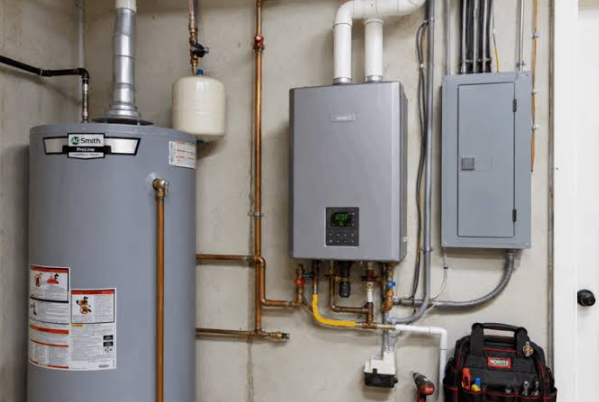

When comparing a gas vs. an electric tankless water heater, there is no single option that is best for every home. Gas models often make sense for households with substantial hot-water demand, while electric models can offer simpler installation in the right home. The better choice depends on household usage, available gas service, electrical capacity, utility rates, and the infrastructure already in place.
For Scottsdale homeowners, including those in McDowell Mountain Ranch, evaluating those factors before choosing equipment can help avoid an undersized system or unexpected installation work.
Gas vs. Electric Tankless Water Heaters: How They Work
Both gas and electric tankless water heaters operate on the same basic principle. They heat water when you need it instead of maintaining a tank of heated water.
The difference is how they produce that heat:
- Gas tankless units use natural gas or propane burners. They are commonly available in higher-capacity configurations capable of supporting substantial hot-water flow.
- Electric units use resistance heating elements. They do not require combustion or gas venting and tend to be compact, but whole-home systems can place significant demands on a home’s electrical system.
Those differences become important once you consider how much hot water your household needs at one time.
Hot-Water Demand Is One of the Biggest Factors
Tankless systems are sized partly according to flow rate, typically measured in gallons per minute. The system must be capable of heating enough water to supply the fixtures that may operate simultaneously.
A household where multiple showers, faucets, and appliances commonly run at the same time can require considerable capacity. Gas tankless systems are often well suited to these higher-demand applications.
Electric tankless units can work well where demand is more moderate, but homeowners should not choose one based on equipment size alone. A compact unit still needs enough heating capacity to deliver the required temperature rise at the desired flow rate.
See also: Rethinking Holiday Lighting: A Smarter Way to Celebrate the Season
Energy Use and Operating Costs
Water heating is a major part of residential energy consumption. According to the Appliance Standards Awareness Project, water heaters account for more than 18% of energy used in a typical home. In homes using natural gas for water heating, the water heater can account for as much as 40% of household gas consumption.
Installation Requirements Can Be Very Different
A gas model needs sufficient fuel capacity to meet its maximum burner demand. Depending on the existing system, that can mean evaluating gas-line size, pressure, pipe length, and the demand from other gas appliances.
Venting may also need to change when replacing a conventional storage water heater with tankless equipment. Some high-efficiency models produce condensate that requires proper drainage.
Although the unit burns gas, electricity is generally still needed to operate controls, ignition, sensors, and fans.
Electric models eliminate combustion venting and do not need a gas connection, but that does not necessarily make installation simple. Whole-home electric tankless units can require considerable electrical capacity. Depending on the model and the home’s existing infrastructure, installation may require multiple dedicated circuits or changes to the electrical panel.
For an existing Scottsdale home, the question is whether the electrical system has enough capacity to support the equipment safely.
Gas Water Heart Replacement Cost
Gas water heater replacement cost depends on several factors. While the equipment you choose is a big part, there are also other things to consider. For example, a direct replacement using compatible existing infrastructure may involve less work than converting from one type of system to another. If gas piping, venting, electrical circuits, the panel, condensate drainage, or water connections need modifications, those changes affect the overall project.
The same principle applies when switching from gas to electric. Eliminating a gas connection does not necessarily reduce the total project cost if significant electrical upgrades are needed.
For that reason, comparing online equipment prices won’t tell you the whole story. The condition and capacity of your home’s existing infrastructure will determine how involved the installation will be.
Maintenance and Long-Term Ownership
Both types of tankless water heaters require ongoing care. Gas systems have burners, combustion components, and venting that should remain in good condition. Electric units eliminate those combustion-related components but still rely on heating elements, sensors, and electronic controls.
Both types can also be affected by mineral scale. That’s significant in Scottsdale, where hard water can leave deposits inside a tankless heat exchanger. Choosing electric instead of gas does not eliminate the need to do descaling and maintenance.
Which Is Usually the Better Fit?
The best choice depends on the home rather than one technology being universally superior.
| Consideration | Gas Tankless | Electric Tankless |
| High simultaneous hot-water demand | Often better suited | May be more limited depending on capacity |
| Existing natural gas service | Can be a strong fit | Not required |
| Gas line | Must provide adequate capacity | Not needed |
| Combustion venting | Usually required | Not required |
| Electrical demand | Typically lower, but power is still needed | Can be substantial for whole-home units |
| Installation space | Compact | Compact |
| Larger households | A strong option | Requires careful sizing |
| Lower or predictable demand | Works well | Can be a good fit |
| Hard-water concerns | Scale management needed | Scale management needed |
Ultimately, a gas vs. electric tankless water heater decision should account for your home’s peak hot-water requirements, existing utilities, installation needs, and expected operating expenses. The same factors should be included when considering gas water heater replacement cost, since infrastructure changes can significantly affect the scope of a replacement or conversion.
Call George Brazil Plumbing & Electrical or schedule service online. Our experienced water heater installation experts can help you choose the tankless water heater that works best for you.


 By
By








 By
By