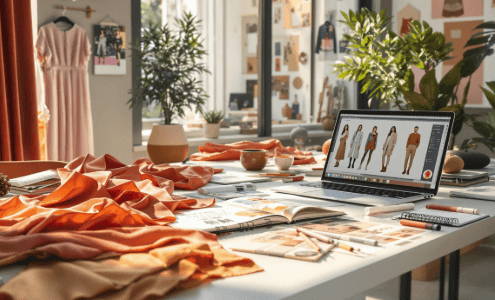

The creative process in fashion has traditionally been a visual-first medium, relying on hand-drawn sketches and technical illustrations to communicate ideas. However, as Artificial Intelligence becomes deeply integrated into the designer’s toolkit, a new method of creation is emerging. The ability to move from a written “Prompt to Prototype” is fundamentally changing how collections are conceived. Through text-to-style technology, the barrier between a creative thought and a three-dimensional reality has never been thinner.
The Power of Descriptive Design
In a traditional workflow, a creative director might have a vivid idea in their mind, but conveying that specific vision to a design team can take days of mood-boarding and sketching. Text-to-Style technology allows designers to bypass these manual steps.
By simply typing a descriptive prompt—such as “A futuristic oversized parka with reflective metallic piping and modular pockets”—the AI can interpret the linguistic cues and generate a high-fidelity 3D model. This shift allows for a more intuitive form of creation, where language becomes the primary brushstroke.
Accelerating the Prototyping Phase
The term “prototype” used to imply weeks of physical labor. Today, a digital prototype can be generated in seconds. This speed offers several transformative benefits for modern fashion houses:
1. Rapid Iteration
A designer can test fifty variations of a single concept in an afternoon. By tweaking the text prompt—changing the fabric type, the silhouette, or the decorative details—the AI provides instant visual feedback. This rapid iteration ensures that only the strongest concepts move forward to the technical development stage.
2. Democratizing Technical Design
Text-to-Style tools empower creative professionals who may not have advanced 3D modeling skills to participate directly in the digital workflow. It lowers the entry barrier, allowing visionaries to produce technical-grade 3D assets through simple communication.
3. Immediate Visual Approval
Stakeholders and buyers can see a concept in 3D long before any physical materials are purchased. This “instant visualization” streamlines the approval process, ensuring that the entire team is aligned on the creative direction from day one.
From Words to Wearables: The Technical Bridge
A common question is how a text prompt can lead to a garment that can actually be manufactured. The sophistication of modern AI fashion tools lies in their underlying technical data. When the AI generates a style based on a text prompt, it isn’t just creating a “picture.” It is building a 3D asset rooted in:
- Garment Logic: The AI understands how seams should connect and how a collar should sit.
- Textile Physics: It applies the properties of the fabrics described in the prompt—simulating the drape of silk or the rigidity of denim.
- Pattern Potential: These AI-generated models can be further refined into 2D patterns, ensuring that the “prompted” design is fundamentally buildable.
Reducing Waste Through Digital Precision
The “Prompt to Prototype” model is a massive win for sustainability. In the old world of fashion, every “bad” idea often resulted in a physical sample that wasted fabric, thread, and energy. In the digital era, “bad” ideas are simply deleted with a keystroke.
By perfecting the design via text-driven 3D models, brands ensure that they only commit resources to designs that have been digitally validated. This significantly reduces the environmental impact of the development phase and minimizes the excess inventory that plagues the industry.
See also: The Importance of Cloud Backup Systems
The Future of Collaborative Creation
As we move toward a more connected digital future, Text-to-Style technology will foster deeper collaboration between human designers and AI. We are moving toward a future where “Co-Design” is the standard. The designer provides the soul and direction through language, and the AI provides the technical structure and speed of execution.
This synergy allows for a level of complexity and detail in fashion that was previously too time-consuming to explore. Intricate pleating, complex layering, and experimental silhouettes can now be prototyped with a single sentence.
Conclusion
The shift from “Prompt to Prototype” is more than just a technological trend; it is the evolution of the designer’s voice. By leveraging text-to-style technology, the fashion industry is becoming faster, more inclusive, and incredibly efficient.
As these tools continue to refine their understanding of fashion nuances, the distance between an idea and a 3D reality will continue to vanish. For the modern designer, the most powerful tool in the studio is no longer just the needle or the pen—it is the ability to describe a vision so clearly that technology can bring it to life instantly.


 By
By





 By
By